

[section id="what-happens-to-a-persons-car-when-they-pass-away" format="overview"]
What happens to a person’s car when they pass away?
When someone dies, their car becomes part of their deceased estate, just like other assets such as property or savings. This means the ownership of the vehicle legally transfers to the estate and must be managed according to the person’s will or, if there is no will, intestacy laws in their state or territory.
Until the executor or administrator of the estate is officially appointed, no one has the legal authority to sell or transfer the car. The vehicle effectively “sits in the estate” until the appropriate legal steps are completed. This ensures the car is not sold or disposed of without proper consent.
In most cases, the car can’t be re-registered, transferred, or sold until probate or letters of administration have been granted. However, the exact requirements may differ slightly across Australia, as each state and territory has its own transport authorities and procedures for deceased estates.
It’s important for families and beneficiaries to understand that selling a deceased person’s car involves both legal and administrative steps, often at an emotional time. By following the correct transfer process, families can avoid fines, delays, and disputes over vehicle ownership.
[/section]
[section id="who-can-sell-a-deceased-persons-car" format="overview"]
Who can sell a deceased person’s car?
Only the executor named in the will, or a court-appointed administrator, has the legal authority to sell or transfer the vehicle from a deceased estate. These individuals act on behalf of the estate to ensure all assets, including the car, are dealt with according to the will or intestacy laws if no will exists.
The executor or administrator may decide to sell the car to settle debts, distribute funds to beneficiaries, or transfer the vehicle directly to a beneficiary. If there are multiple beneficiaries, the sale or transfer must be handled in accordance with the estate plan or legal rulings.
Family members, including a spouse or next of kin, cannot sell the car unless they are formally appointed as the executor or administrator. This prevents disputes and ensures the transfer of ownership is legally valid.
Before the car can be sold, the executor or administrator may need to obtain probate or letters of administration, depending on the state or territory in which the estate is located. Once granted, they can work with the relevant transport authorities to finalise the vehicle ownership transfer or sale.
[/section]
[section id="what-documents-are-needed-to-transfer-ownership" format="ul"]
What documents are needed to transfer ownership?
To transfer ownership of the vehicle from a deceased estate, the executor or administrator must provide a set of legal and administrative documents to the relevant transport authority in their state or territory. These documents prove that the person handling the transfer has the legal authority to act on behalf of the estate.
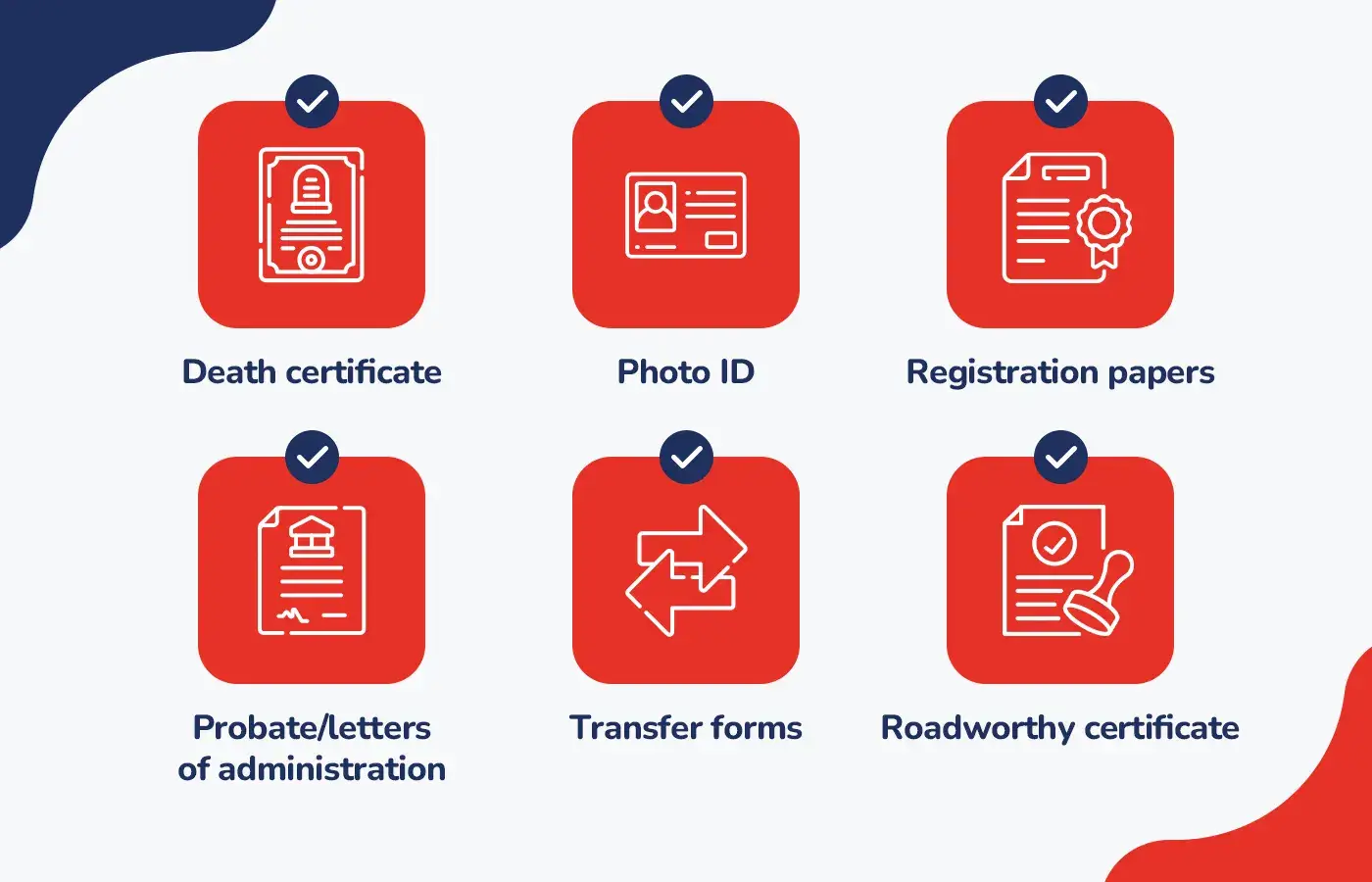
Commonly required documents include:
- Death certificate: A certified copy confirming the registered owner has passed away.
- Proof of identity: Usually, a photo ID of the executor, administrator, or beneficiary.
- Vehicle registration papers: To verify the current ownership of the car.
- Grant of probate or letters of administration: Depending on the state, these provide legal authority to transfer or sell the vehicle.
- Completed transfer of ownership forms: Each state (e.g., Service NSW, VicRoads, Department of Transport WA) has specific paperwork requirements.
- Roadworthy certificate (if required): Some states require this before transferring registration to a new owner.
If the car is being transferred to a beneficiary, additional documentation, such as a will or estate plan, may be required to support the transfer. If the property is being sold privately or to a buyer, the executor must also ensure that stamp duty and any applicable transfer fees are paid correctly.
Providing the correct documentation upfront helps prevent delays, fines, or disputes during the vehicle ownership transfer process.
[/section]
[section id="what-happens-if-the-car-is-still-under-finance" format="ul"]
What happens if the car is still under finance?
If the deceased person’s car is still under a finance agreement, the outstanding loan must be cleared before the vehicle can be sold or transferred. The car serves as collateral for the loan, which means the lender has a legal claim over it until the balance is repaid.
The executor or administrator of the deceased estate should contact the finance provider as soon as possible to inform them of the death and request a payout figure. This figure outlines the total amount required to settle the loan.
There are a few common scenarios:
- Estate pays out the loan: Using estate funds to settle the debt before transferring ownership.
- Beneficiary assumes the loan: If permitted by the lender, a beneficiary may refinance or take over the existing loan.
- Lender repossesses the car: If the loan can’t be repaid, the lender may reclaim and sell the vehicle to recover costs.
In all cases, the finance must be finalised before ownership can legally be transferred or the vehicle sold. If the executor tries to sell the car without clearing the loan, the buyer may inherit the debt or face repossession.
For transparency and to avoid legal complications, it’s crucial to confirm the PPSR (Personal Property Securities Register) status of the vehicle. This check will reveal whether there is a secured loan, lease, or other financial interest registered against the car.

[/section]
[section id="do-you-need-to-go-through-probate-to-sell-a-car" format="overview"]
Do you need to go through probate to sell a car?
In most cases, yes, you need to go through probate or obtain letters of administration before you can legally sell a deceased person’s car. Probate is the legal process that confirms the will’s validity and authorises the executor to manage and distribute the estate assets, including the vehicle.
If the deceased person had a valid will, the executor applies for a grant of probate. Once probate has been granted, the executor has the legal authority to transfer ownership or sell the vehicle on behalf of the estate.
If there is no will, a next of kin or an eligible person applies for letters of administration. This gives them the legal right to act as the administrator of the estate, which is required before dealing with assets such as vehicles.
Some states may allow exceptions. For example, if the vehicle’s value is below a certain threshold, or the estate is very simple, the transport authority may transfer the car without formal probate. However, these exceptions vary across Australia, so it’s important to check the relevant transport authority in your state or territory.
[/section]
[section id="do-rules-differ-between-states" format="ul"]
Do rules differ between states?
Yes, the rules for transferring ownership or selling a deceased person’s car differ slightly across Australia. Each state and territory has its own transport authority, transfer forms, and probate requirements. Understanding these differences is essential to avoid delays, fines, or incomplete transfers.
Here’s a quick overview of how requirements vary:
- New South Wales (NSW) – Through Service NSW, you’ll usually need a grant of probate or letters of administration, a certified death certificate, and proof of identity. If the estate is small, Service NSW may allow a simplified transfer.
- Victoria – VicRoads requires a completed transfer form, the death certificate, and either probate, letters of administration, or evidence that you’re the authorised executor or administrator. A roadworthy certificate may be needed if the car is being transferred to a new owner.
- Western Australia (WA) – The Department of Transport requires similar documentation, but may have different thresholds for when probate is required. Executors must submit the appropriate transfer form and proof of authority.
- Queensland, South Australia, Tasmania, ACT, and Northern Territory – Each jurisdiction has its own paperwork and may have different rules for stamp duty, transfer fees, or when probate is necessary.
Because the transfer process isn’t uniform nationwide, the executor or administrator should always check with the relevant transport authority in the state or territory where the vehicle is registered. This ensures the vehicle ownership transfer is completed correctly and avoids complications later.
[/section]
[section id="steps-to-sell-a-car-from-a-deceased-estate" format="steps"]
Steps to sell a car from a deceased estate
Selling a car from a deceased estate involves several legal and administrative steps. Following the correct transfer process ensures that the vehicle ownership is handled properly, avoiding delays, fines, or disputes between beneficiaries.
[section_inner_1 id="step-1-confirm-who-has-legal-authority-to-act" format="overview"]
Step 1: Confirm who has legal authority to act
The first step is identifying the executor named in the will or, if there is no will, the court-appointed administrator. Only this person has the legal right to transfer ownership or sell the car. If the executor hasn’t yet been appointed, you may need to wait for probate or letters of administration to be granted.
[/section_inner_1]
[section_inner_1 id="step-2-notify-relevant-parties" format="overview"]
Step 2: Notify relevant parties
The executor or administrator should notify transport authorities, insurers, and (if applicable) finance providers about the death of the registered owner. This ensures the car isn’t sold, transferred, or insured under the wrong name.
[/section_inner_1]
[section_inner_1 id="step-3-gather-required-documents" format="overview"]
Step 3: Gather required documents
Collect all the documents needed to transfer the vehicle, including the death certificate, proof of identity, vehicle registration papers, and any probate or letters of administration documentation. A roadworthy certificate may also be required if the car is transferred to a new owner.
[/section_inner_1]
[section_inner_1 id="step-4-finalise-any-outstanding-finance" format="overview"]
Step 4: Finalise any outstanding finance
If the car is still under finance, contact the lender to obtain a payout figure and settle the loan using estate funds or an alternative approved method. The loan must be cleared before the car can legally be transferred or sold.
[/section_inner_1]
[section_inner_1 id="step-5-check-state-specific-requirements" format="overview"]
Step 5: Check state-specific requirements
Different states have different rules. Check with the relevant transport authority (e.g., Service NSW, VicRoads, Department of Transport WA) for forms, stamp duty rules, and thresholds regarding probate, as well as whether it is required or not.
[/section_inner_1]
[section_inner_1 id="step-6-complete-the-transfer-of-ownership" format="overview"]
Step 6: Complete the transfer of ownership
Once the paperwork and any financial obligations are in order, the executor or administrator can transfer the vehicle to the beneficiary or new buyer. This involves submitting transfer forms, paying any stamp duty, and lodging the required documents with the transport authority.
[/section_inner_1]
[section_inner_1 id="step-7-sell-the-vehicle" format="overview"]
Step 7: Sell the vehicle
The car can now be sold through a private sale, auction, or via a professional car buying service like 1800 Car Buyers. The executor should keep records of the sale price and payment, as these funds form part of the deceased estate to be distributed according to the will or intestacy laws.
[/section_inner_1]

[/section]
[section id="can-1800-car-buyers-help-with-deceased-estate-cars" format="cta"]
Can 1800 Car Buyers help with deceased estate cars?
Yes, 1800 Car Buyers can help simplify the process of selling a car from a deceased estate. We understand that managing legal paperwork, dealing with transportation authorities, and navigating probate can be overwhelming during an emotionally challenging time.
Our team works closely with executors, administrators, and family members to ensure the process is as smooth as possible. Once you have the required documents and legal authority in place, we can provide a fast, fair quote, handle the transfer paperwork, and arrange free car removal nationwide.
We also request the Grant of Probate (if applicable) or a death certificate and the will to ensure that we are communicating with the executor or appointed individual who can sign away the vehicle.
With instant Osko payments, competitive offers, and no hidden fees, we offer a trusted and transparent service. Whether you need to sell a deceased person’s car quickly or want support finalising the transfer of ownership, 1800 Car Buyers can manage the process from start to finish.
[/section]
Table of contents

