


[section id="factors-influencing-car-resale-value" format="overview"]
Wondering how much your car is worth before you sell? It’s a smart place to start. Knowing your car’s value can help you compare offers, choose the right selling method and avoid settling for less than it’s worth.
Your car’s price depends on more than its make and model. Age, kilometres, condition, service history, accident history and current buyer demand can all shape what someone is willing to pay. Market factors like fuel prices, location and seasonal demand can also make a difference.
In this guide, we’ll explain what affects your car’s value, how to check the market value of your car and how to get a fast quote when you’re ready to sell.
[/section]
[section id="what-is-your-car-worth-key-valuation-factors" format="overview"]
What affects the value of your car?
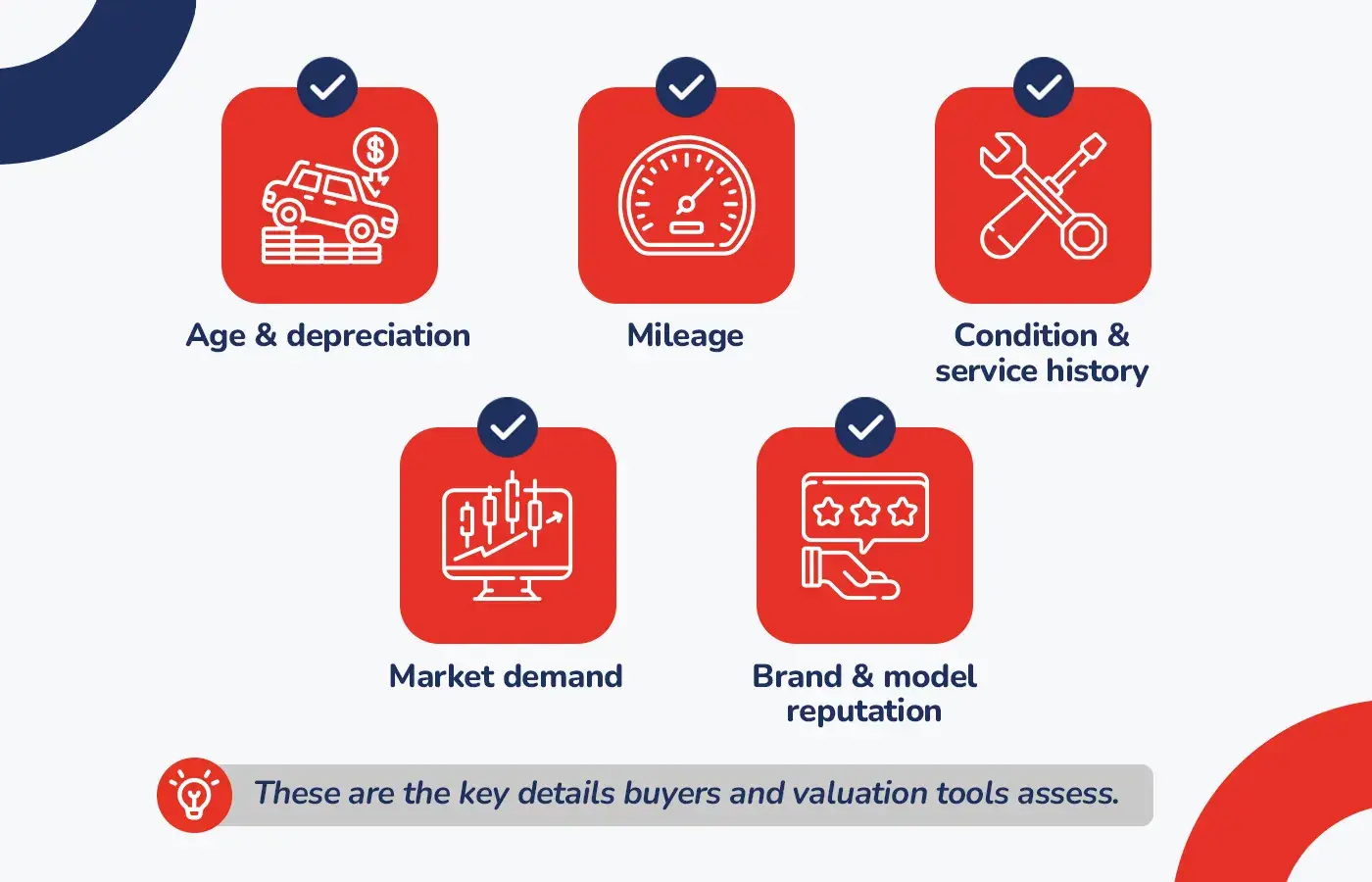
Your car’s valuation comes down to more than its make and model. Buyers and valuation tools look at several key factors before estimating a realistic resale price.
[section_inner_1 id="age-and-depreciation-determine-base-value" format="overview"]
Age and depreciation
Most cars lose value as they get older. This is called depreciation.
In Australia, new cars can depreciate significantly in their early years, with some estimates suggesting they may lose up to 15%–20% annually. After this initial drop, depreciation typically slows, but age continues to influence buyer interest and price expectations.
For example, a 2022 SUV will usually be worth more than the same model from 2016, even if both have been well-maintained.
[/section_inner_1]
[section_inner_1 id="mileage-signals-wear-and-future-costs" format="overview"]
Kilometres travelled
Lower odometer readings usually increase resale value, as they suggest the car has been driven less and may have fewer mechanical issues ahead. High mileage often reduces buyer confidence and affects both private-sale prices and dealer offers.
For example, a car with 60,000 km will usually be worth more than the same model with 180,000 km, assuming both are in similar condition.
[/section_inner_1]
[section_inner_1 id="condition-and-service-history-affect-perceived-reliability" format="overview"]
Condition and service history
Condition can make a big difference to your car’s value.
A well-maintained car with regular servicing records, clean interiors, and no accident history is likely to receive higher valuations. Buyers often pay more for cars that feel 'ready to drive' with minimal upfront investment required.
Valuations will depend on:
- Dents, scratches or paint damage
- Interior wear and tear
- Tyre condition
- Mechanical issues
- Warning lights
- Accident history
- Rust or structural damage
[/section_inner_1]
[section_inner_1 id="market-demand-shapes-price-fluctuations" format="overview"]
Market demand
Your car’s value also depends on how many people want to buy that type of vehicle.
In Australia, popular utes, SUVs and reliable small cars often hold value well. Fuel-efficient cars may become more attractive when petrol prices are high, while 4WDs can be in stronger demand before holiday periods.
Demand can also vary by location. A small hatchback may be popular in Melbourne or metro areas, while utes and 4WDs may attract more interest in Queensland or more regional areas.
[/section_inner_1]
[section_inner_1 id="brand-and-model-reputation-influence-long-term-value" format="overview"]
Brand and model reputation
Some brands and models hold their value better than others.
Cars with a reputation for reliability, affordable servicing, and strong resale value are often worth more on the used-car market. Brands like Toyota, Mazda, Hyundai, Subaru and Ford often perform well because buyers know and trust them.
Less common models can still sell, but they may take longer to find the right buyer.
[/section_inner_1]
[/section]
[section id="how-do-different-buyers-value-your-car-differently" format="comparison"]
How to find the market value of your car?
There are several ways to find the market value of your car in Australia, but each method offers a different level of accuracy. The best approach is to compare multiple sources to understand both estimated ranges and realistic selling prices.
Check online car valuation tools
Online valuation tools like RedBook and Carsales offer a quick way to estimate your car’s value. They use historical sales data to generate a price range, making them a useful starting point. However, they don’t always reflect real-time demand or your car’s exact condition.
Compare similar car listings
Looking at similar listings helps you understand how your car is priced in the current market. Focus on vehicles with the same make, model, year, and mileage in your area. Keep in mind that listing prices are often higher than what cars actually sell for.
Review recent sales data
Sales data shows what similar cars have actually sold for, giving you a more realistic view of market value. This helps you avoid overestimating your car based solely on listing prices.
Get quotes from dealers or car buyers
Quotes from dealers or car buyers reflect what buyers are willing to pay at the moment. These offers take into account your car’s condition, location, and current demand, making them useful if you’re planning to sell soon.
Combine multiple methods for accuracy
No single method gives a complete picture. Using a mix of tools, listings, and quotes helps you arrive at a more accurate and realistic price range.

Online car valuation tools: how accurate are they?
Online car valuation tools are a useful starting point if you’re looking to sell and want a quick estimate of your car’s value. A free online car valuation or car value calculator uses market data, recent sales, and your car details to give you an estimated valuation range based on similar vehicles in the Australian market.
Think of these tools as a benchmark, not the final word. Use them to understand your car’s general value range before approaching private buyers, dealers, or car-buying services. Combining online valuations with real-time quotes, such as instant offers from 1800 Car Buyers, gives you a more accurate picture of your car’s true market value.
How different buyers value your car
Different buyers view your car differently. This is why you may receive different offers depending on where you sell.

[table]
[thead]
[tr]
[th]
Buyer Type
[/th]
[th]
Valuation Focus
[/th]
[th]
Typical Offer
[/th]
[th]
Ideal For
[/th]
[/tr]
[/thead]
[tbody]
[tr]
[td]
Private Buyers
[/td]
[td]
Condition, presentation, mileage, and emotional appeal. Buyers often value service history and aesthetics.
[/td]
[td]
Usually the highest price if demand is strong.
[/td]
[td]
Sellers who want to maximise price and are willing to wait.
[/td]
[/tr]
[tr]
[td]
Dealers
[/td]
[td]
Resale potential, auction data, reconditioning costs, and profit margins.
[/td]
[td]
Lower than private sale to account for margins.
[/td]
[td]
Sellers trading in for convenience or a new car deal.
[/td]
[/tr]
[tr]
[td]
Car-Buying Services
[/td]
[td]
Market data, demand, and vehicle condition. Focused on speed and convenience over negotiation.
[/td]
[td]
Competitive instant offer paid quickly.
[/td]
[td]
Sellers who value a fast, secure, hassle-free sale.
[/td]
[/tr]
[/tbody]
[/table]
Private sale
Selling privately can sometimes get you a higher price, especially if your car is in great condition and demand is strong.
The downside is that it takes more work. You may need to take photos, write a listing, answer enquiries, arrange inspections, handle negotiations and wait for the right buyer.
Trade-in
Trading in your car is convenient if you’re buying another vehicle from a dealer. However, trade-in offers are usually lower because dealers need to resell the car and make a profit.
If you’re wondering how much your car is worth as a trade-in, keep in mind that trade-in value is usually different from private-sale value.
Car-buying services
Car-buying services like 1800 Car Buyers offer a faster and simpler way to sell. You can get a quote, accept the offer and arrange collection without dealing with listings, tyre-kickers or long negotiations.
This can be a good option if you want a fair price without the stress of selling privately.
[/section]
Should I fix my car before selling it?
It depends on the repair.
Small improvements can sometimes help increase your car’s value or make it easier to sell. For example, cleaning the car, replacing worn tyres or fixing small cosmetic issues may help create a better first impression.
But not every repair is worth it.
Expensive mechanical repairs may cost more than the extra value they add. If your car is older, damaged or no longer running well, it may be better to sell it as-is rather than spending money you might not get back.
Repairs that may be worth doing:
- Cleaning and detailing
- Replacing worn tyres
- Fixing minor dents or scratches
- Repairing small interior issues
- Completing overdue servicing
Repairs that may not be worth doing:
- Major engine repairs
- Transmission repairs
- Expensive panel work
- Repairs that cost more than the value they add
If you want to sell quickly, 1800 Car Buyers can provide a quote for your car in its current condition. That means you may not need to spend time or money fixing it before selling.
Sell your car fast with 1800 Car Buyers
Want to know what your car is worth without the guesswork? 1800 Car Buyers makes it simple to get a fast offer based on your vehicle and current market demand.
Start with a quick online form, and we’ll provide a direct quote for your car. There’s no need to create listings, wait for private buyers, negotiate with strangers or spend money on repairs before you sell your car.
With 1800 Car Buyers, you can enjoy:
- Fast pick-up, often within 24 hours
- Secure Osko payment
- No hidden fees
- A simple, no-pressure process
- Support from a local team
Whether your car is used, damaged, high-kilometre or simply no longer right for you, we’ll make the selling process simple.
Get your free valuation today and see how much your car is worth.


.svg)